Context
Mann Library at Cornell had partnered with USDA agencies on the Economics, Statistics and Market Information System (ESMIS) since the 1990s, hosting and maintaining a repository of agricultural reports and datasets for public access. By the time I joined, the library was undertaking the next major revamp of the system, and I was hired specifically for this grant-funded project. The new iteration would be built on Samvera, an open-source repository platform built on Ruby on Rails, rather than built from scratch.
Starting point
Samvera provided a functional base system, but little of what made the experience usable for this specific audience and content existed yet. My work was primarily about customizing, branding, and extending that base platform — and, where useful, contributing improvements back to the open-source project. I was one of two or three designers involved, but held primary design vision and ownership. This was also my first experience working in Ruby on Rails, which required a real learning investment alongside the design work itself.
Approach
Because the system served two very different audiences, I approached it as two connected design problems: a public discovery/consumption experience, and a staff-facing content-management experience. On the public side, content was organized by agency — NASS, FAS, AMS, ERS, and WAOB — and then by category, such as dairy, livestock, and grains, which mapped naturally onto how the agencies already organized their own work. On the staff side, I worked through a large, detailed metadata and tagging system needed to properly classify and surface thousands of reports and datasets, testing it directly with the people who’d actually use it.
Key decisions
Public discovery and notifications
Users could browse and filter by agency and category, and subscribe to notifications at multiple levels of specificity — by agency, by individual publication, or by category (for example, any new dairy report from any agency).
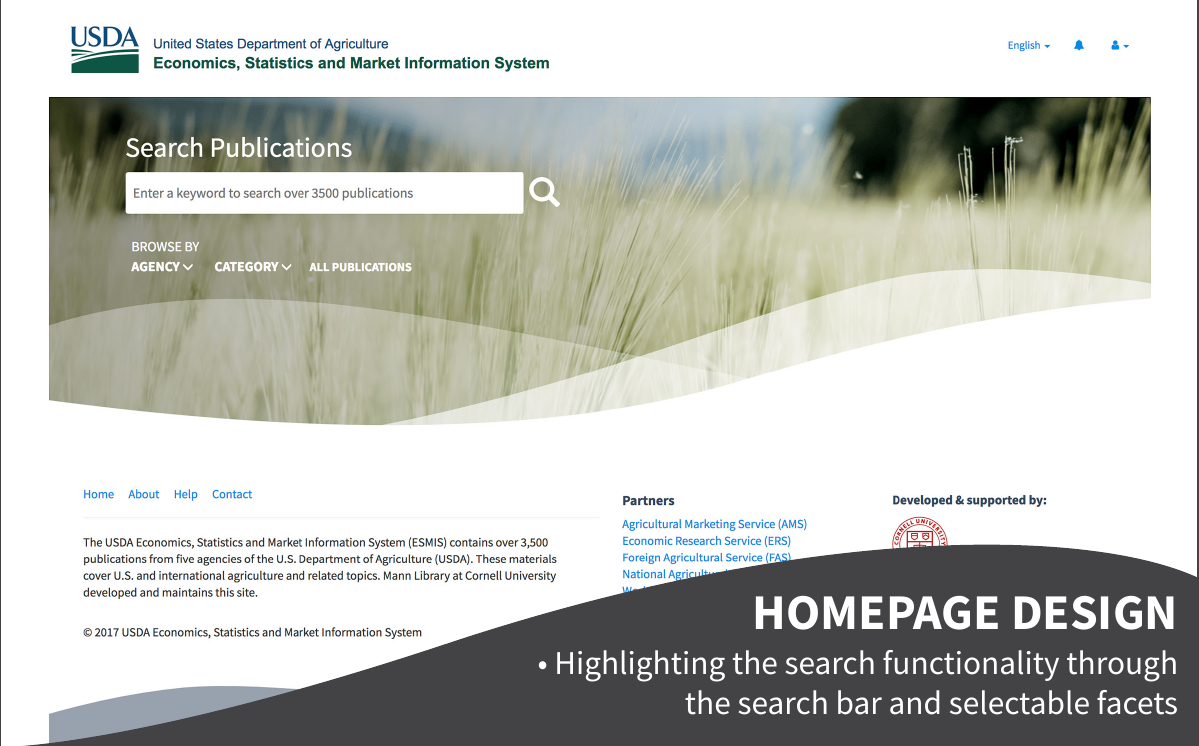
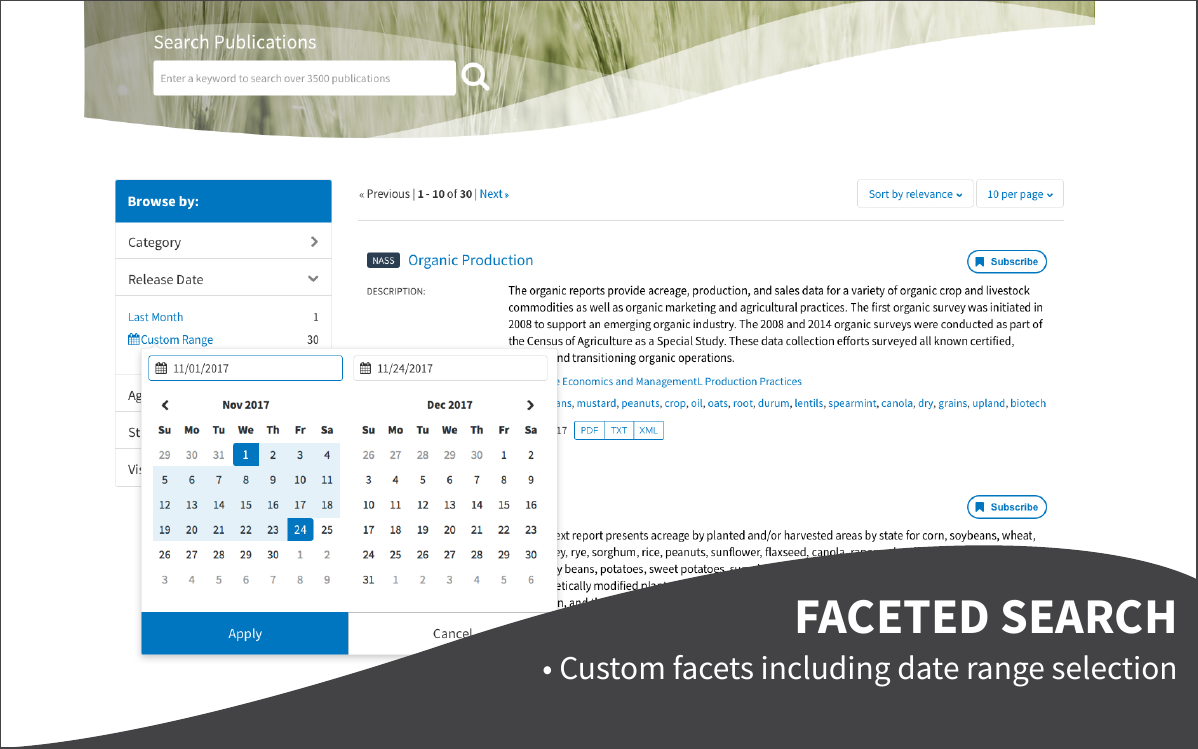
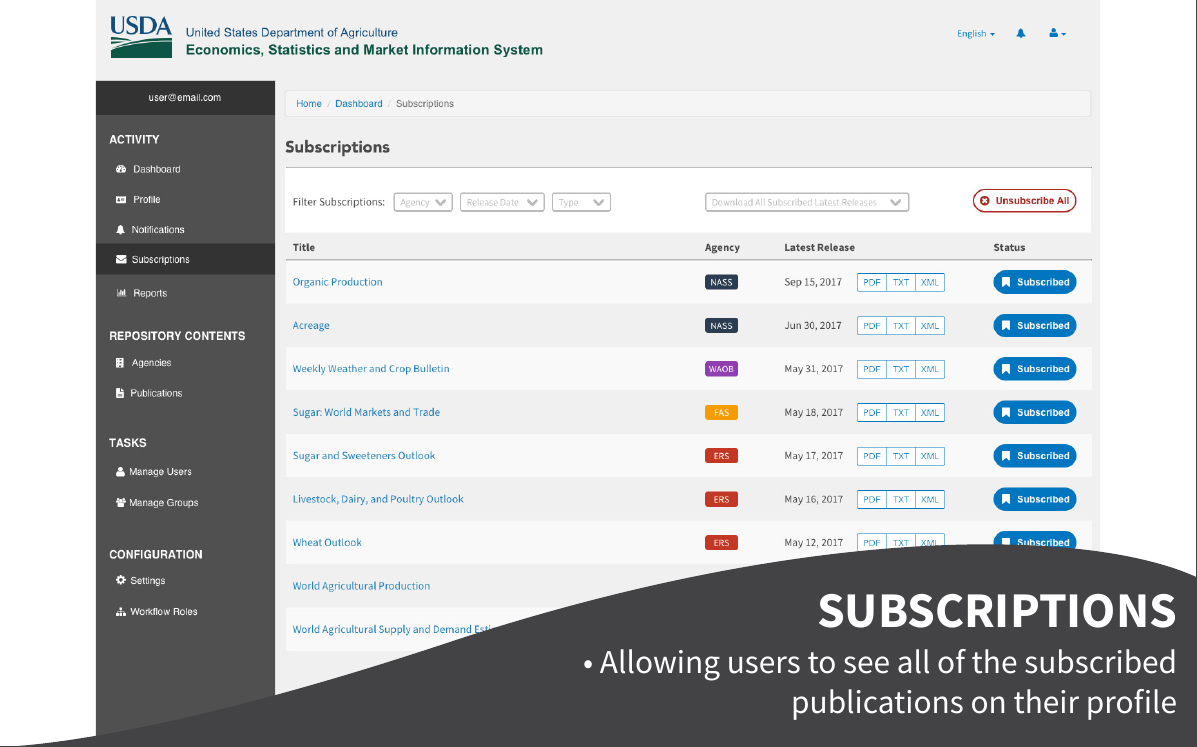
Screenshots recovered from a 2017 conference poster documenting the project — the highest-resolution source still available for the original design.
Staff publishing workflow
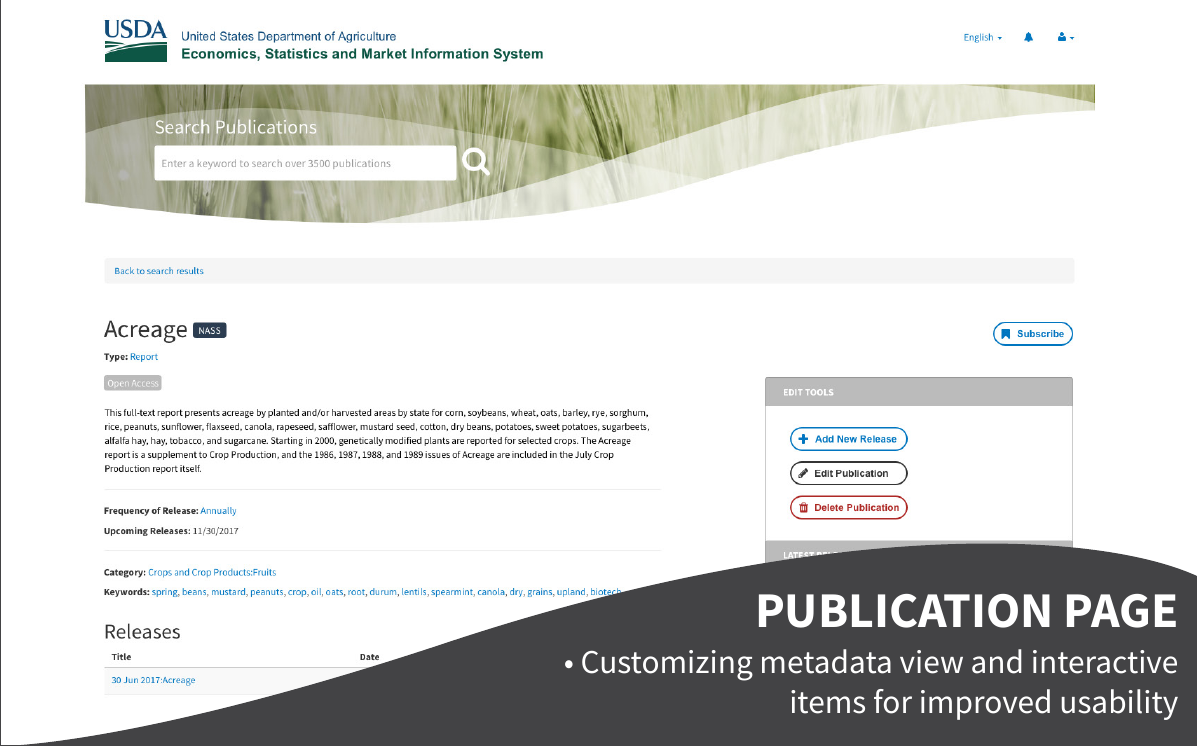
The back-end upload and tagging system involved a large number of fields and required significant design thought to make the metadata/tagging process usable for USDA staff, several of whom I tested with directly. This was one of the more demanding parts of the project, given the volume and specificity of metadata needed to keep the repository properly organized.
Accessibility
The project required Section 508 compliance at a time when web accessibility practices were far less mature and widespread than they are today, making this early, foundational work in an area that would later become central to my professional focus.
Release-time reliability
Some USDA publications are time sensitive, so minimizing downtime and ensuring reports displayed clearly and immediately upon release was a serious constraint, particularly on the front end.
Open-source platform extension
Working within Samvera meant learning how to extend and customize an existing open-source system rather than designing freely from scratch — a different discipline than my later APA work, and one that gave me a lasting appreciation for open-source communities and collaborative software development.
Collaboration & iteration
I conducted direct usability testing with USDA staff on the back-end publishing workflow during meetings. I was also a member of the Usability Working Group, which ran regular testing sessions with student participants — not a perfect match for the system’s actual audience, but valuable for validating general navigation and flow patterns.
Launch & outcome
The redesigned system launched around 2018, roughly a year after I joined Cornell. Over the following years, I gathered ongoing feedback directly from USDA staff about what was and wasn’t working, and iterated accordingly.
A note on the system today
I left Cornell about four years ago, and I’m not certain of the system’s full history since. A version of the site still exists on a usda.gov domain, though it appears to have been simplified from the original design.
Reflection
This was my first large-scale, publicly visible project, and my first experience working with open-source software — both significant professional turning points. What I valued most was the direct, ongoing relationship with the USDA staff who used the system daily: being able to talk with them, understand their real workflows, and keep improving the tool for people I could actually watch and learn from. This project confirmed that UX was the right path for me, and taught me how to ask better questions of specialized users to uncover real problems.